Saturday, October 6, 2012

Top Five Photos of the Week


Not having time at present to write a really long post, I thought I would close the week out with my five favorite photos from this week. I took about three hundred this week, a typical number for me, but I was finally able to figure out how to do some special effects on my camera (!!). I also took the bus on Friday to Nice on a beautifully clear day and discovered some sites (actually in a park built around the ruins of a medieval château) that offered panoramic views! So, here it goes!


5. Sun over the Sea


This picture was taken on top of what is now my favorite walking spot in Antibes,  the Chemin du Calvaire and the Bois de Notre-Dame (more on that later). Panoramic views abound!


4. White Niçois Flower


I discovered a patch of these flowers near a square in Nice. It's hard for me to pass up taking nature close-ups!


3. Vividly Colorful Windows

I love the variety of architecture and windows in the Riviera! But I confess: I did have my camera set on super-vivid.


2. Lighthouse Miniature

This was right after I discovered a Pandora's box of special effects on my camera. Needless to say, I was having a ball with all of them, including the miniature effect which fades the top and bottom of the picture to make the object in focus look, well, miniature.


And, finally, the picture of the week (drum roll please)......
Wait for it..........


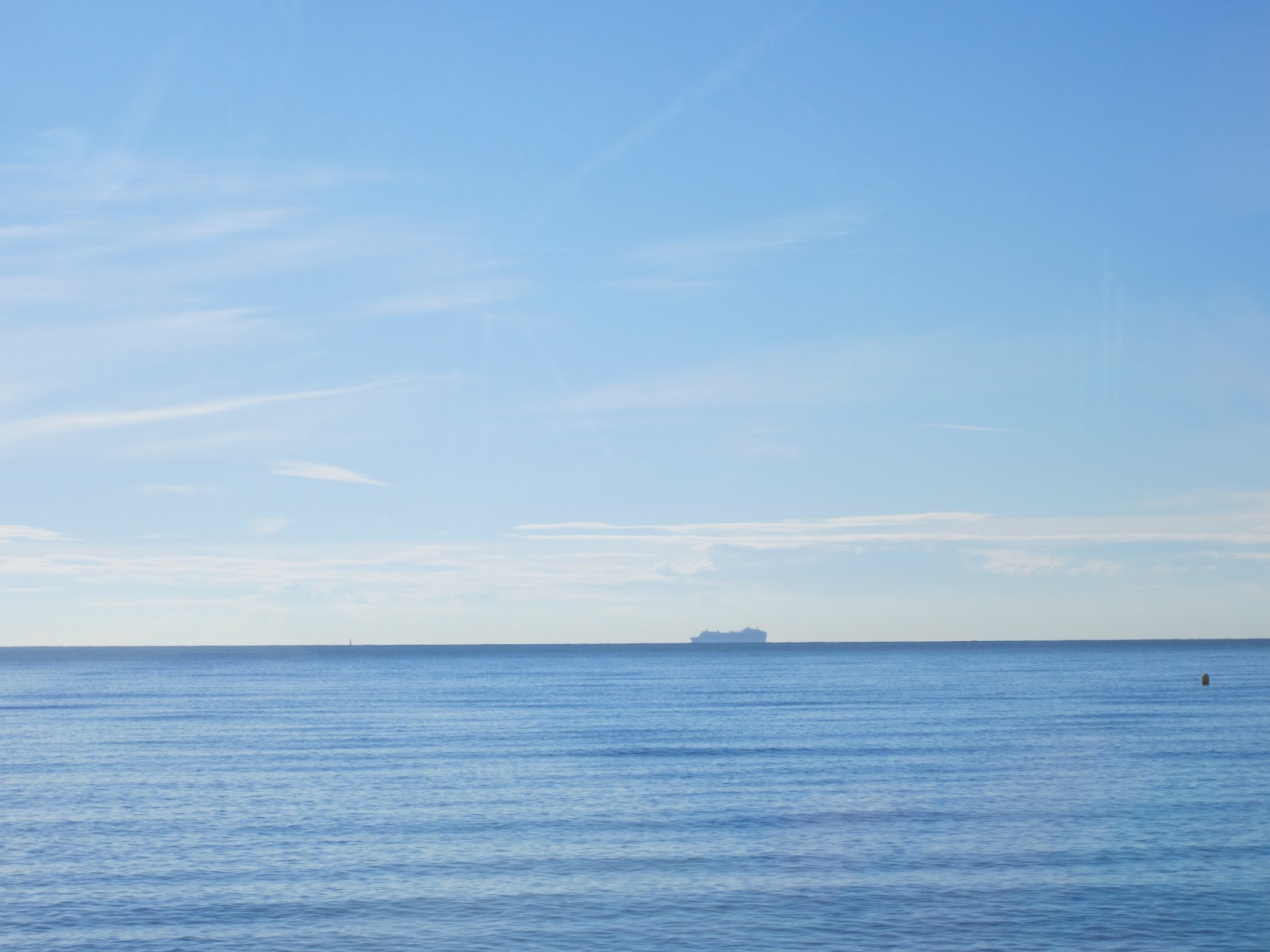
1. The Heavens Declare the Glory of God

I snapped a bunch of pictures of this scene from La Colline du Château (the Hill of the Castle) in Nice looking out over the Mediterranean Sea, but this one was the best of all of them. It gives me goosebumps, not because of my photography abilities at all (which aren't as good as many people I know), but because of the sheer wonder of the beauty of God's creation!


Thursday, September 27, 2012

Of Plazas, Perfumes, and Principalities

I left off last time with a teaser for my next post. Hopefully, I left my readers with breathless anticipation! It's only been a few weeks, but I already have a LOT of catching up to do.

My last blog post left off with me settling into life in the Riviera among the French. So, let's begin on Tuesday, September 4, after I arrived here in France.

It was such a lovely day that day! (Not that there are many here that are that bad.) All of us in the same study abroad group met at a bus stop next to the Port Vauban, which is one of the more common places to find yachts, as one can see in the background of this picture.
The sign at the bottom says "EAU NON POTABLE" (NON-DRINKABLE WATER)  for those who might try to drink from an obviously decorative fountain.


We had a bus just for us that started driving toward Nice. Needless to say, I was snapping pictures every few seconds.
Cruise ships: They're everywhere during September.
Eventually, we arrived in Nice and were joined by a French girl in her 20s from the nearby village Villefranche who acted as our tour guide. We drove on the beautiful Promenade des Anglais, one of the longest seaside boulevards in the world. Unfortunately, I didn't get a good picture of the street itself, but the view beside it looked like this:
I can't take enough pictures of the sea. :)
As we wound through the narrow streets of the fifth largest city in France, there were all kinds of random things to see since the city has been an attraction for foreigners for a couple hundred years now. For instance, the picture below is of everyone's favorite queen, Queen Victoria of England.
Queen Victoria being offered a specialty of four cities of the Riviera --Nice, Antibes, Cannes, and Grasse
Queen Victoria actually stayed in Nice for a while and rented out half of this building, which is now called the Regina Hotel in her honor (not that great a picture, I know, but the best I could do from a moving bus):
Imagine being able to say that you slept down the hall from Queen Victoria's room!

There is so much to see in this city that one could live here for a year without seeing all of it! The most unusual thing in Nice is a Russian Orthodox cathedral à la Moscow.
Looks like something out of a fairy tale, doesn't it?
"What in the world is a Russian Orthodox cathedral doing in the middle of a French city?," you might be asking yourself. Well, in fact, Nice was a favorite vacation spot for the Tsar and his family during the late 1800s (Nicholas II's father, I think, but I'm not sure). Since the Tsar and his family were living in Nice for a while, a lot of the Russian court would come too and enjoy the sun with them. However, there was no Russian Orthodox church here, so they eventually decided to build one of their own here in the Riviera. This part of the Riviera is still popular with Russians today.

Anyway, back to our bus ride. The bus climbed up a hill next to the city to a spot where there was a fantastic view of the Mediterranean and the city below.
I'd never seen water so blue!
Afterwards, we were taken back down into Nice and dropped off for our walk into the old city of Nice with its famous flower market. However, before we stopped, I saw a statue that reflected the Italian roots of the city: a statue of Giuseppe Garibaldi, who was responsible for uniting Italy into one nation.
Europeans love naming streets after all sorts of people and having statues of them everywhere too.
Nice, or Nizza in Italian, and all of the region around until Antibes were actually Italian until 1860, being under the protection of the Counts of Savoy. However, the people of Nice decided by referendum in 1860 to become French rather than be part of Garibaldi's united Italy.

The market in Nice is absolutely amazing! On one side, one finds bread, meat, cheese, and all sorts of trinkets and household items, but on the other side is one of the beauties of the city: the Marché aux Fleurs.
Flower prices are a lot cheaper here, too!
Stands filled with thousands of flowers line the sidewalks near a large square in Nice. I've never seen so many colorful flowers in one spot before!

Our resident director told us that it might be wise to buy a snack in the market since we were going to have a late lunch in Monaco, so this is what I bought:
The little ones still look rather large...
One of the "little" ones only cost 95 cents! I could hardly believe it! It tasted really good though, albeit it took me a while to eat all of it.

On the way out of Nice, we stopped to have a look from afar at the most expensive villa in the world. From what I remember, it was built by one of the kings of Belgium and subsequently bought by the owner of the Ferrari company. Since he has died, his widow is selling it for a few hundred million dollars. Should any of you have that lying around, you can put it to good use here!
No, I haven't filled out a change of address form yet.
Eventually, we made our way back to the beautiful old hilltop village of Èze, which boasts one of the two perfume factories of the Fragonard company, which is based out of Grasse, the perfume capital of France. I didn't know nose-candy existed until I went there! This is some of the expensive perfume (and cologne) that people buy in New York City, but here it's only 20 EUR or so for a bottle. Axe? *contemptuous sniff* Please.
Needless to say, some of the girls in our group were excited to  tour this place.
The town is from the 1200s, built on top of a hill overlooking the sea. The town seemed to be filled with a feeling of nostalgia for medieval times and a tinge of sadness for how time had changed. The town used to have a fortress, but that was torn down by Louis XIV when he invaded the territories of Savoy. (Keep in mind that this town was Italian until just 150 years ago.)

Château of the lord of the city
The stone streets and arches of the village were very picturesque.
Inside the village's cathedral
After a whirlwind visit of the village, we all piled into the bus again for the trip to the climax of the trip: a trip to the Principality of Monaco. The tiny country is actually made up of two cities: Monaco City, the capital, and Monte Carlo, the location of the world-famous annual Grand Prix. The two cities are squeezed into a country less than a square mile in size with 35,000 people. To make room for this many people, the country has built up with tall buildings on the hillside and built down with extensive construction underground. In fact, there's even a promenade underground where people go to walk without having to worry about all of the Rolls-Royces, Ferraris, etc., around. The principality still contains many vestiges of its beloved American princess, Grace Kelly, who was killed in 1982 in a car crash at this spot:
Grace Kelly's fatal car wreck occurred at the curve just ahead, which was also the scene for the picnic that she had with Cary Grant in the movie "To Catch a Thief," the movie she was filming in Monaco when she met her future husband, the prince.
The picture displayed of Grace Kelly was taken near this sign. There are other signs around Monaco that depict different scenes from her life as a princess.

After a little wait at the border, we drove through into Monaco and parked in an underground garage. The prince's palace was not that far of a walk (of course, a "far" walk isn't really that possible in Monaco), and I was really eager to see my first honest-to-goodness palace!
The Royal Palace of the Prince of Monaco
On top of the door is the coat of arms of the Grimaldi family, which has ruled Monaco since the 13th century. The depiction of two monks with raised swords deserves an explanation. In 1297, the founder of the Grimaldi rule of Monaco, François Grimaldi (or Francesco Grimaldi, depending on what language you're speaking), could not openly take the virtually impregnable fortress of Monaco with his followers. So, he, his cousin Rainier I and his soldiers disguised themselves as friars and were greeted as such at the gate of the castle. However, as our tour guide told us in her delightful French accent, "instead of pulling out prayer books, they pulled out swords." Thus the two "monks" are François and Rainier I. As Paul Harvey would say, "now you know...the rest of the story."
The tour guide didn't mention what the Catholic Church thought about people impersonating monks to take over a castle. I guess it depended on which side was in good with the Pope...

And here's a statue near the palace of François Grimaldi himself, the cousin of the present prince's great-great-great-great-great-great-great-great-great-great-great-great-great-great-great-great-great-great-great-great-grandfather. Yeah, this royal house has been around awhile.
Wow, I wish I could sculpt that well.
At this point, our resident director sent us out on our own for an hour and it began to rain lightly over the square. So, I went on a short quest to seek out souvenirs and, more importantly at the moment, lunch. In the area of lunch, I was able to find a little something in a café:
This, ladies and gentlemen, is a croque-monsieur. As I have described it before, think of the best ham-and-cheese sandwich you've ever had and multiply that by ten. There is also such a thing as a croque-madame, which is basically the same thing with an egg added. You may now proceed to salivate.
As far as souvenirs go, well, I guess you'll find out after I get back to the States. :) I will say that I found some post cards for a nice collage I'm planning to make after I get back.
By the way, here's what the streets near the palace look like:
Elbow room doesn't really exist here unless you live in the palace--or a boat. Monaco is not for people with claustrophobia.

After returning to our resident director and our tour guide like ducklings to the mother duck (the analogy kept presenting itself to me), we walked down a street to one of the other most famous buildings in Monaco: Saint Nicholas Cathedral, otherwise simply known as Monaco Cathedral. This cathedral is where Grace Kelly married Prince Rainier II and where she, her husband, and many of the other princes and wives of princes are buried.
The outside of the cathedral


The ornate altar
The grave of Princess Grace behind the altar
All of the names on the graves behind the altar are in Latin. So, her name is engraved as Gratia Patricia.
I didn't really want to leave that cathedral, BUT we only had limited time to see the rest. We drove down to Monte Carlo and saw some of the roads where the Grand Prix takes place every year. It takes the country weeks to prepare for a race that lasts for only an hour and a half.
The slowest part of the race. Hard to see why, isn't it?
By this time, we were all feeling rather worn out, but there was one more place we had to go: the Casino Monte-Carlo.
Monaco also doubles as the Las Vegas of Europe.
Cameras are not allowed inside, probably because celebrities don't want compromising pictures taken of them and sold to paparazzi. Suffice it to say that the inside is EXTREMELY ornate with sparkling chandeliers, expensive carpet, and beautiful ceilings. However, in case you're wondering, I did not see anyone famous, and I did not gamble.

A few of us thought we'd go look inside a neighboring casino called the Hôtel de Paris. We were able to get inside but were summarily dismissed by the guy who was supposed to be at the door but wasn't.
A view of the casino from the garden across the street from it
Here I am at the fountain in front of the casino:
Wouldn't you know it, the fountains all started up right after I came down from  taking my pictures of the casino. :/ Oh well!
And here's one of my favorite pictures from the day:

At first glance it almost looks like the bust is in the fountain. At least, that's what I thought when I was reviewing the picture.


By this time, we were all worn out from walking all day long. After a bus ride of an hour or so we finally found ourselves back again in our "hometown" of Antibes. The nice thing is that I found out that I can get a round-trip ticket to Monaco for five euros, so I am definitely going back on my own before I leave!

In the next few days, I continued my explorations in Antibes and discovered some of the most beautiful nature scenery I've seen so far! But that will have to come later. 'Til next time, then!

Wednesday, September 5, 2012

Au Bord de la Mer

“Well, I’m finally here,” I thought to myself as my plane landed in Nice Côte d’Azur Airport about sixteen hours after flying out from the airport in Lubbock, Texas. I had been really glad to leave Frankfurt because the airport seemed rather dismal and everyone spoke German. (Most of the German I know I learned from watching the old TV show Hogan’s Heroes.) Even before that, I was rather displeased with Lufthansa because they so happened to be having scheduled crew member strikes in Frankfurt the day I left the United States (8/31). Those strikes, along with a flat tire on the plane, were part of the reason my flight from Houston to Frankfurt was delayed by an hour and a half. So it was with a little apprehension and a little excitement that I looked out my window on the plane from Frankfurt to Nice and saw the clear blue water of the Mediterranean Sea sparkling in the midday sun of the French Riviera.

Picture of Nice Côte d'Azur Airport
After taking a shuttle from the airplane to the airport, I followed the signs all the way to the baggage claim. (They were in French and English so don’t feel TOO proud of me.) There were a herd of people all around the baggage claim for my airplane since two other flights had just landed, and I had to stand on my tip-toes to see the luggage as it flew past the long belt. (It was going at a pretty good clip for a baggage claim.) However, I was eventually able to approach the belt, only to have it stop suddenly. For the next fifteen minutes, the luggage just sat there, half in the baggage claim and half behind. In the meantime, they moved some of the luggage to another baggage claim without telling us and then proceeded to fix the line.

As the luggage moved past, I began to feel my heart beating faster because I didn’t see anything that looked like my luggage.

Insert scary music.
“Great,” I thought. “Here I am just landed in Nice after a sixteen-hour flight, and I only have the change of clothes I stuck in last minute in my backpack.”

I walked rather nervously up to a counter that looked as if it had something to do with lost baggage, only to find out after a rather long wait in line that I was at the wrong place. The rather miffed lady behind the counter told me in a French accent that I needed to go down to the Lufthansa desk, which was nowhere to be seen. I moved off feeling rather dejected, homesick, and tired when I happened to glance by the baggage claim for oversized baggage.

To my overwhelming relief, my baggage was sitting off the oversized line as if it were waiting for me!

I grabbed it and hurried off to the customs desks since I was already late for my pick-up by the study abroad program. Nevertheless, what should appear before me but empty customs desks! I stood there puzzling over that one and wondering if I could go ahead and go through, but I saw a few other people just walking through, so I did the same. Thank the Lord, an older tanned man with a witty smile
was holding a CEA sign, still waiting for me!

He took the three of us he had come to meet out to a van and loaded all of our luggage, after which he drove us from Nice to Antibes, which is about a twenty-minute ride. I quickly realized that the French drive as if they’re riding roller coasters.

Okay, not that bad, but the concept's the same.
The driver whirled around roundabouts as if they weren’t even there, missed
other cars by just a few inches, and sped down tiny streets with cars parked on both sides—all while blithely chatting in French to the lady who accompanied him. 

After dropping off the two girls who had also been picked up, I was taken to the Boulevard de Président Wilson, where I met Kristin Kerr, the resident director for the program. She was really excited to see me and hurried me over to an apartment building similar to those found in New York and other big cities, with seven stories and a doorbell on the door for each apartment. I clambered into the elevator inside and arrived on my host mom’s floor. Madame Françoise Mazza, an older lady in her sixties or seventies, greeted me with my first French bisou and showed me into her quaint little French apartment. At the same time, I met my roommate, Dennis, who had arrived a week earlier.

Dennis took me down to the two stores nearby, and, for lack of anything better at the moment, I bought a frozen pizza for supper. It was not actually that bad, though I was a little intimidated at first by ham and mushrooms. Ah, well! I suppose desperation and exhaustion can make you do things you wouldn’t ordinarily do…

Looks gross but tastes surprisingly all right.


Anyway, I eventually met the four study abroad girls who live in an apartment just below Madame Françoise’s and then proceeded to take one of the most appreciated showers I’ve ever had. Let’s just say that I slept really soundly that night. That was even more amazing because the window in our room was open onto the busy boulevard all night long, almost a necessity for my roommate and me because the French are not really big on air conditioners.

Things proceeded rapidly the next few days. All of the study abroad students who had arrived already had an orientation meeting at a little crêperie down the street, where I had my first pain au chocolat (my latest addiction) and an espresso to honor my sister Stacey’s wishes that I try one at least once. Afterwards, she took us on a tour of our neighborhood, especially Vieil Antibes, or Old Antibes, which comes complete with quaint narrow streets, pedestrian pathways, a cathedral, a wall first built by the ancient Greeks, and, of course, a beautiful view of the Mediterranean sea with the city of Nice in the distance and low mountains behind.
One thing I am definitely going to be longing for when I come back

After a day or two, Madame Françoise—she’s like a French grandmother, by the way—taught me how to make a really good quiche, though some of the ingredients would be difficult to find in the States.
Quiche, glorious quiche!

On Monday, our study abroad group traveled by bus to our university here, SKEMA Business School, where we had an orientation and those of us wanting to take French had to take a really difficult evaluation. I only had about ten minutes to scribble something down in French for the essay question, which asked me to describe myself mentally and physically. I did my best, but I keep imagining the amused expression on the grader’s face when he sees them. The best part was when I only had two minutes and so I hurriedly started scribbling down a whimsical physical description that became especially silly when I wrote, “Moi, j’ai des lèvres grande.” (“I have big lips.”)

Yes, I still have to study SOME while I'm here


Well, I hate to have to stop writing, especially since I haven’t until now broached the subject of our day excursion into Nice, the beautiful hilltop village of Èze, and the climax, Monaco. But it’s getting late, and I need to go shower “avant me coucher” (before going to bed). À bientôt (See you soon)!
A taste of what's to come

Friday, April 20, 2012

A Reflection on Literacy

So last week I had to write an essay for a study abroad academic merit scholarship and was really enjoying writing it (which only happens when I'm writing about something that I firmly believe). Unfortunately, I was just about to submit everything when I realized that I had gone off topic in my essay and I had to modify it. But fear not! I saved the original one since I figured it would make a good, thought-provoking blog post. Here is the result.

Wednesday, December 14, 2011

The blessing of acappella singing and shape notes

Sacred Harp Singing

This past weekend, some friends of mine and I dressed up and sang at an event that occurs every year out here in West Texas called Candlelight, where people come and tour the restored buildings from the 19th and early 20th centuries at the National Ranching Heritage Center while people reenact what people then might have done during the holiday season. We have been singing in what used to be a train station (that has awesome acoustics by the way--wood floor and high ceiling, etc.) for four or five years now, and some of the same people are in there with us every year. However, every year some of them ask us questions such as how long we have been together as a group, whether we have made any CDs of our singing, and where we learned to sing. We respond every time that we have not sung much as a group, though we might sing in the same congregation sometimes. In fact, we hardly ever sing as a group except at this event. Yet the people that ask seem rather astounded when we tell them that. These questions--plus the fact that the people that pass by on their tour often seem to be so attracted to our group singing that they will sometimes stick around to hear the song we are singing at that time all the way through--lead me to ask myself, Is our singing that unusual? Don't people usually sing older hymns this time of year anyway?

Now, bear in mind that I do not mean to flaunt our singing talents to the world by writing the previous paragraph. In fact, few of us have had any formal musical training, that is, unless week-long summer singing schools are defined to be "formal" musical training. Thus the fact that we cause such reactions, although flattering, was rather unexpected the first year we sang in the train station. Be that as it may, the two things that I believe we have going for us are our lifelong experience with acappella singing and shape notes.

With those two things in mind, I can begin to see why our singing seems to be such a novelty. First, few in our day have sung many acappella hymns and have not had the opportunity of hearing the powerful old hymns that were written two or three hundred years ago to be sung acappella. In addition, many of the well-known songs that are sung this time of year such as "Hark, the Herald Angels Sing," "O Come All Ye Faithful," and "Silent Night" sound different without the instruments. It seems that older hymns such as those contain a sound that is covered up by instruments but comes through like a soft yet brilliant light when sung without them--especially in a room with great acoustics. Some people that come through the tour--especially those who are musically inclined--are drawn to that sound and do not want to leave it.

Second, many people find it rather unusual that we are able to up and sing a song without at least pulling out a pitch pipe and without rehearsal, and yet we are able to sing four parts harmoniously and sometimes even produce overtones. Many of us who lead songs--including me--cannot say right off the bat what key a song is written in because we pitch songs by ear, not by the key. This leads to another fact about singing acappella for a long period of time: You have to be able to hear the other parts, hear what you are singing, and know whether it sounds right with no help from a piano, guitar, or any other instrument. 

Shape notes do help a lot, though. The most common shape-note system is the seven-note system, which has a shape for every note on the scale (do, re, mi, fa, sol, la, and ti) as shown on the first line below.
This system of notation is great for acappella singing because one always knows where every note on the scale is, and so one can use relative pitch to pitch a song without relying on an instrument.

Nevertheless, the most important ingredient that I believe attracts people to our singing every year is the fact that no instrument can match the instrument that God Himself made--especially when sung with the Holy Spirit's blessing by people who believe every word they are singing and have grown up learning the shape notes and singing that kind of music. Furthermore, the words are more powerful and present more vivid images than many written today. One of the songs we sang last weekend was a Sacred Harp song named "Lloyd," whose words are as follows:

My Savior and my King,
Thy beauties are divine;
Thy lips with blessing overflow,
And ev'ry grace is Thine.

The smilings of Thy face,
How amiable they are;
'Tis heav'n to rest in Thine embrace
And nowhere else but there.

Nor earth, nor all the sky,
Can one delight afford;
No, not a drop of Thy real joy,
Without Thy presence, Lord.


The last verse says it pretty well: The best things on earth (including singing) cannot be truly delightful without God's presence. In the end, we should all pray that we may have His presence whenever we meet to sing.

Saturday, December 10, 2011

"Joy unspeakable and full of glory"

I love how the Old Testament seems to have more and more joyful passages the closer the Biblical timeline gets to the birth of Christ. Consider that all of these passages were written either during the decline of Judah or after the Babylonians destroyed the kingdom:
"Sing, O daughter of Zion; shout, O Israel; be glad, and rejoice with all the heart, O daughter of Jerusalem. The Lord hath taken away thy judgments, he hath cast out thine enemy: the king of Israel, even the Lord, is in the midst of thee: thou shalt not see evil any more. In that day it shall be said to Jerusalem, Fear thou not: and to Zion, Let not thine hands be slack. The Lord thy God in the midst of thee is mighty; He will save, he will rejoice over thee with joy; he will rest in his love, he will joy over thee with singing." --Zephaniah 3:14-17
"Sing and rejoice, O daughter of Zion: for lot, I come, and I will dwell in the midst of thee, saith the Lord. And many nations shall be joined to the Lord in that day, and shall be my people: and I will dwell in the midst of thee, and thou shalt know that the Lord of hosts hath sent me unto thee. And the Lord shall inherit Judah his portion in the holy land, and shall choose Jerusalem again. Be silent, O all flesh, before the Lord: for he is raised up out of his holy mountain." --Zechariah 2:10-13
"Rejoice greatly, O daughter of Zion; shout, O daughter of Jerusalem: behold, thy King cometh unto thee: he is just, and having salvation; lowly, and riding upon an ass, and upon a colt the foal of an ass." --Zechariah 9:9
"And I will pour upon the house of David, and upon the inhabitants of Jerusalem, the spirit of grace and of supplications: and they shall look upon me whom they have pierced, and they shall mourn for him, as one mourneth for his only son, and shall be in bitterness for him, as one that is in bitterness for his firstborn."
--Zechariah 12:10
If the prophets could be this joyful during a time of decay and destruction, then we have no excuse but to imitate them. Now, don't get me wrong: I am not talking about some sort of Pollyanna-like "glad game" really. Rather, we should be joyful in the fact that Christ has come and saved us eternally. In fact, we actually have even more reason than Zephaniah or Zechariah or any of the other prophets had to be joyful, because that which they saw dimly in the future we now see in the light of the present day. Anyway, I think it fitting to put in a happier post since my last posts have been rather--shall we say--gloomy.
P.S. Zechariah 12:10 (the last passage listed above) is a very intriguing verse of Scripture to me. It prophesies that the Jews will mourn for Him Whom they have pierced (a phrase which points almost explicitly to Jesus Christ). Although I believe this verse was partially fulfilled on the Day of Pentecost when Peter preached to his brethren, I also wonder if it points to a future time yet to be seen when a glorious Christian revival will sweep across the Jewish people. As Paul said in Romans 11:5, "Even so then at this present time also there is a remnant [among the Jews] according to the election of grace." How awesome it would be to see that day, if that is indeed the day to which these verses--one in the Old Testament, one in the New--refer.
P.P.S. Another element common to all of these Old Testament verses is that of singing. The concept of singing to the Lord is seen throughout the Bible as an integral part of worshiping God, alongside prayer. Moreover, my personal belief is that we should sing to Him using the purest instrument in existence: the voice, the only instrument designed by God Himself.

Friday, August 12, 2011

Yet more ponderings

Yes, I admit it. I've been guilty of reading through the prophetic books of the Old Testament just because--well--it's still part of the Bible, you know, and I should probably read through them since the New Testament quotes them so much--I mean, at least for reference purposes. Of course, the beautiful Messianic prophecies of Isaiah especially catch one's attention, but haven't we all been a little guilty at one time or another of zoning out somewhat when Isaiah and the other prophets begin warning of destruction against such-and-such unpronounceable city or such-and-such country that was located over somewhere in that region thousands of years ago or the Somethingorother-ites that sometimes sound like something out of a modern Dr. Seuss book? In other words, we are tempted to maintain a rather detached view of these prophecies since they'd already been fulfilled (at least, most of them) by the time Jesus Christ lived on this earth.

However, as I'm reading through the Old Testament again, somehow I seem to notice more than I ever had before how--well--really modern the prophets sound in their judgments against nations and kingdoms. Take Isaiah 31:1 for example: "Woe to them that go down to Egypt for help; and stay on horses, and trust in chariots, because they are many; and in horsemen, because they are very strong; but look not unto the Holy One of Israel, neither seek the Lord." Now, at first glance, I'm tempted to glaze over when it comes to the part about horses and chariots since those haven't been used as weaponry for centuries and when it talks about wanting Egypt to help since nobody gets help from Egypt today (in fact, there the ones that need help now...). However, that misses the point of this verse entirely. Perhaps recent events in the news regarding toppling governments and economic uncertainty around the world have given this verse fresh vigor for me. What Isaiah is saying here if you peel back the layer of historical terms is really, "Trusting in alliances or modern weaponry--including (especially nowadays) the power of money--isn't going to save your nation when you've turned away from God." In fact, the verse states that woe will come to those who trust in those things. Sounds rather modern, doesn't it?

In short, when one peels back the layers of names of countries and cities that have been dust-piles for the longest time, one finds that the prophecies have lost none of their fire at all. In fact, they seem to be refulfilling themselves today. Once again, "The thing that hath been, it is that which shall be; and that which is done is that which shall be done: and there is no new thing under the sun" (Eccl. 1:9). God hasn't changed his attitude toward nations who, like Israel, have forsook him as a nation or are forsaking him (think "America"); nor has he changed his attitude toward the heathen nations like Assyria, Babylon, Edom, Moab, Philistia, etc., who have never as a whole worshiped him as the one and only God (e.g., the Muslim nations of the Middle East). This is the part when I get that shiver up and down my spine because of what history teaches happened to those nations: utter destruction. The city of Tyre, which was viewed at one time as the harbor of the nations, was torn down and literally dragged into the sea. Today, it's just a fishing town (fulfilling Ezek. 26:14). Jerusalem was burnt with fire and the temple was destroyed, first by the Babylonians and finally by the Romans. To this day, it has never regained its magnificence and splendor. With all this in view, what does that mean for us? Are we to suffer their fate? God's word is clear: our nation's destruction will come, unless we repent. Countless times in the Old Testament Israel is instructed to turn and repent to save herself from destruction, but she did not during the final days of the kingdom of Israel first and the kingdom of Judah afterwards, and was destroyed. We would do well to take heed to that warning.

The following is a poem that I wrote after reading through Jeremiah 9, one of the saddest passages of that book, yet a glimmer of hope (from verse 24) remains at the end:


Jeremiah's Lamentation:
A Poetic Paraphrase of the Ninth Chapter of the Book of the Weeping Prophet

O that I could but weep and cry,
For on my nation God's wrath doth lie!
O that I could fly from the vile,
E'en if to some deserted isle!

But God is just; He sees their work--
He sees that they His laws do shirk.
From evil they cannot be still,
And regard not Him on Zion's hill.

They lie, they all; there's not a soul
Whose reputation is all whole.
E'en family one can't believe,
For lies abound, and truth doth leave.

A bond, a pact, is worthless now;
They teach their tongues lies to allow.
Fatigued and tired are they from sin,
Yet do they walk e'en more therein.

For th'land I weep--it is on fire;
The flames do rise continually higher.
The beasts and birds, they all do flee.
No person in the towns I see.

Who is the wise one who doth know
For what the land doth perish so,
And why the wilderness is burned,
That travelers from it must turn?

Yet saith the Lord, "My judgment's right,
For from My laws they do alight,
And after their own hearts do walk;
To bow to idols they do not balk.

"Yea, verily may they weep and cry,
For I cruel waters do apply.
Yea, verily may they mourn and wail,
For I their false hopes do assail!"

Cruel death is come into our land,
And there is none to lend a hand
To bury all the dead around,
For dead men shall so much abound.


"Let not the wise their wisdom boast;
Let not men trust in pow'r and hosts,
And let not rich men's glory be
Their wealth, their great prosperity.

"But let their glory ever be
To understand and to know Me,
The great Jehovah, Adonai,
And to me let them send their cry.

"In lovingkindness, judgment right,
And righteousness I do delight,
But let them not trust in their work,
For punishment in that way doth lurk."

And that ends yet another post that is much longer than I ever anticipated, but I hope it still remains thought-provoking although rather (all right, very) wordy. Goodbye for the present!